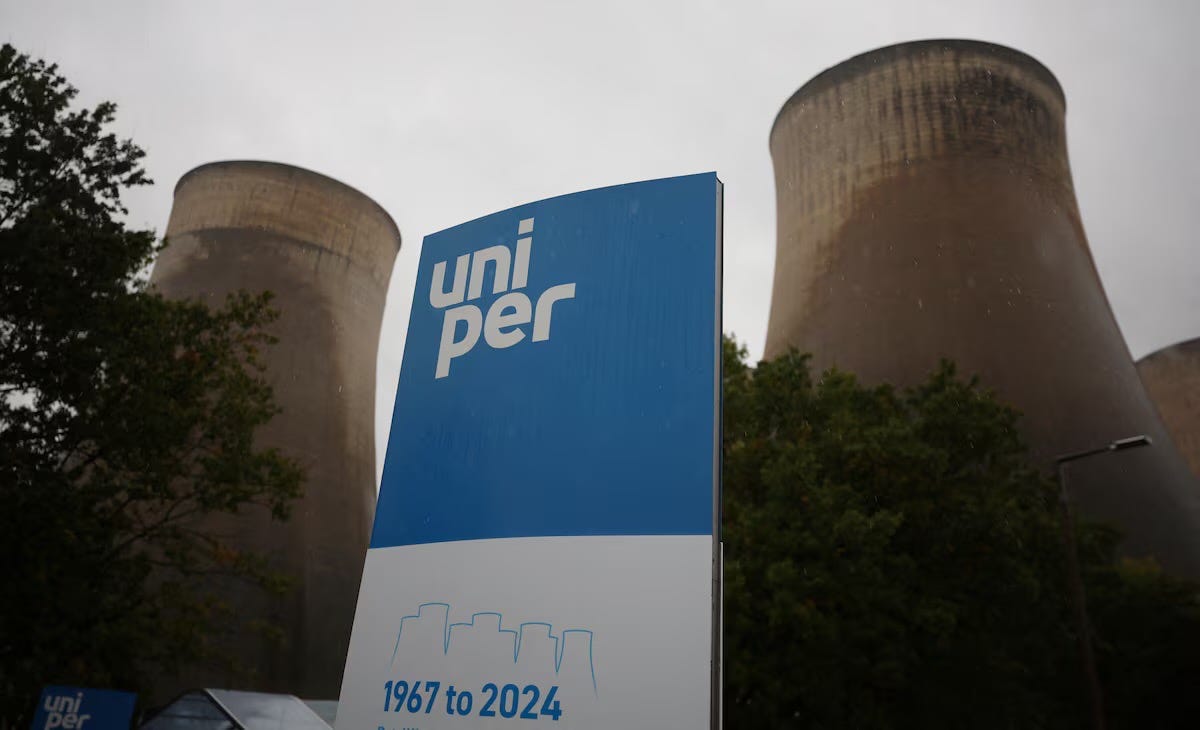
Uniper: Political Dead Money or Europe’s Next Energy Re-Rating
Most investors still think Uniper is dead money.
That’s usually the moment when an infrastructure re-rating starts.
Uniper is still framed as a political rescue case, a leftover from the energy crisis, something uninvestable until the state is gone. That framing misses what is quietly happening underneath. Winter stress, gas demand reality, and Germany’s power system redesign are pushing Uniper back into a position of structural relevance. This is not a buy call. It’s a setup you want to understand before the narrative flips.
Uniper is not a “German utility stock.”
It is continental European energy infrastructure hiding inside a politically distorted equity.
The current situation Uniper sits at the heart of Germany’s gas and power system. Import, storage, generation, balancing. This is not optional infrastructure. In winter conditions, when gas demand spikes and the system is stressed, Uniper is one of the entities that keeps the lights on. That role does not disappear just because headlines do.
Winter front equals stress test Winter is not about weather headlines. It is about demand volatility, procurement discipline, storage optimization, and short-term price exposure. Periods like this separate operators from passengers. Uniper is an operator. These phases remind policymakers and markets who actually runs the system.
Why Uniper matters beyond Germany This is not a local story. Germany is the industrial core of continental Europe. Gas flows, storage, and power balancing in Germany ripple across neighboring countries. Uniper is a systemically relevant node for Europe, not a peripheral utility.
The ownership problem Today, Uniper is effectively state-owned. The German government holds the vast majority of the company following the 2022 rescue. This matters because state ownership almost always caps valuation. Political objectives dominate capital allocation, risk appetite, and return targets. Markets hate that.
The state has to exit This is not ideological. It is structural. Germany committed to reducing its stake over time as part of the EU-approved rescue framework. Reprivatization is not optional. It is a condition. Timing and structure are open questions, but the direction is clear.
Why reprivatization is the real catalyst As long as the state controls Uniper, this is a politically managed asset. Once the state exits meaningfully, Uniper becomes an investable equity again. Normal governance. Normal capital allocation. Normal return expectations. That transition alone can drive revaluation, even if the business stays the same.
The gas power plant strategy Germany’s energy transition requires dispatchable backup capacity. Wind and solar need firm power behind them. The answer is new gas-fired power plants designed to be hydrogen-ready over time. This is now explicit policy.
Uniper’s positioning Uniper is positioning itself as a core player in this strategy. Large-scale gas generation, system integration experience, and balance sheet relevance. If Germany builds new gas capacity through auctions and contracts, Uniper will be at the table.
Why this matters economically These plants are not speculative merchant assets. They are likely to come with capacity payments, long-term contracts, or regulated-style returns. That means visibility. Stability. Cash flow quality. Exactly what Uniper lacked during the crisis years.
The setup Short term volatility driven by weather, gas prices, and politics. Medium term driven by two structural levers. Reprivatization of ownership. Execution of the gas power plant strategy.
Both are underappreciated by headline-driven narratives.
What to watch Progress on government exit plans. Design and economics of gas power plant auctions. How much of Uniper’s earnings normalize into repeatable cash flows post-crisis.
Bottom line Uniper is still treated as a politically impaired rescue case. That is precisely why it belongs on a serious watchlist. If and when reprivatization becomes real and Uniper locks in its role in Germany’s gas power strategy, the market will be forced to reprice it. Not because it is exciting, but because it is unavoidable infrastructure.
This is not a buy recommendation.
This is a revaluation watch.
If you want to think like an owner, not react like a trader, become part of the FJ Research community.
We focus on durable businesses, structural mispricing, and patient capital.


